Cape Town’s oldest university has a new Convocation President. Alumni who love and bless Israel say she won’t promise to represent them.
Here’s what you need to know in sixty seconds: the University of Cape Town has an alumni body called Convocation. In December 2025, its members elected a new President, Dr Yumna Moosa, along with four of her allies to its Executive Committee. Within hours, a WhatsApp message went out celebrating the win — not as a victory for alumni generally, but as a defeat of what it called “the Zionist bloc.” Alumni who noticed the overlap between the WhatsApp authors and the newly elected Executive have now expressly asked a simple question: will you represent all of us — including those who stand with Israel — or just some of us? So far, the answer has been silence.
For those of us who take seriously God’s word to Abraham — “I will bless those who bless you, and whoever curses you I will curse” (Genesis 12:3) — this is not a distant campus squabble. It is a small but telling test of whether love for Israel and the Jewish people can still be spoken aloud in South African public life without penalty.
How UCT got here
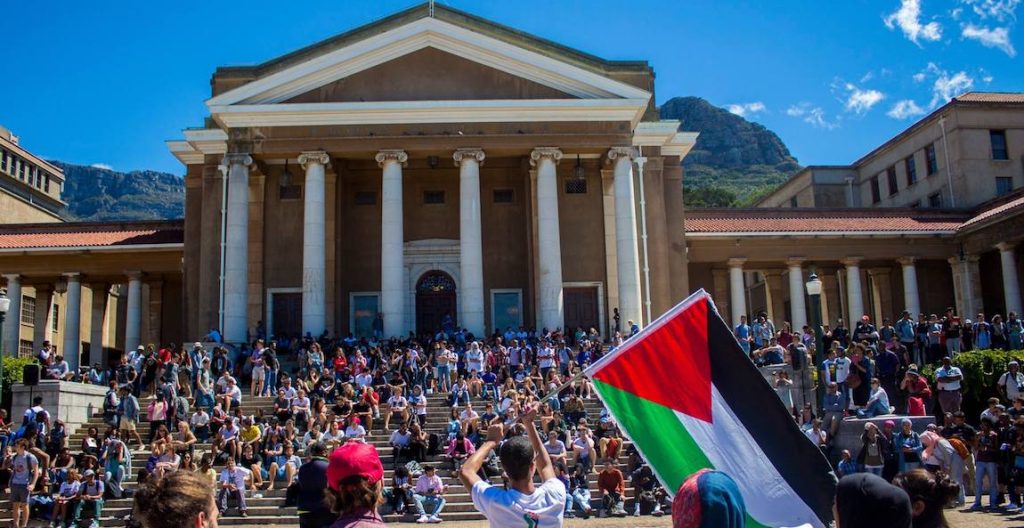
UCT’s Convocation is supposed to be a forum for all graduates — tens of thousands of them — to weigh in on how their university is run. Turnout is usually tiny. In late 2025, a group calling itself UCT Alumni for Palestine changed that, mobilising its supporters to register, vote and run a slate of candidates for the Executive.
It worked. Dr Moosa became President. Four of the five other seats went to figures with documented ties to the same network: Anthony Fish Hodgson and Caitlin Le Roith (leaders in SA Jews for a Free Palestine who declare themselves anti-Zionists), Marion Stevens and David Le Page — the exact slate a UCT Alumni for Palestine Facebook post had named as the one it was “backing,” on 4 December 2025.
Then came the WhatsApp message. Addressed to “Comrades and Friends,” signed off by a “coordinating committee” that named Anthony and Yumna among its members, it declared:
“We resolutely defeated the Zionist bloc… Together, we will ensure that UCT never becomes a home for racism or for Zionists who support the genocide in Gaza.”
Read that again. This wasn’t a private opinion shared after a protest. It was a message celebrating an election to a body that exists to represent every UCT graduate — Jewish, Christian, Muslim, secular, those who stand with Zion and those who don’t. And it was signed, at least in spirit, by people who now hold the two most powerful offices in that body.
An alumni activist group, UCT Renewal, laid out the conflict of interests concern in a formal document circulated to the Executive: most Jews, whatever their individual politics, believe Israel has a right to exist. Christian Zionists share that conviction not as a political preference but as a matter of biblical conviction — that God has not forgotten His covenant with the Jewish people, and that the modern State of Israel is bound up with His promises. If “Zionist” is the label an elected leader has pledged to keep out of “home,” then every believer who prays for the peace of Jerusalem, and every Jew who simply affirms Israel’s right to exist, has effectively been told they don’t belong.
A simple ask
UCT Renewal didn’t demand anyone’s resignation. It asked for two things, on the record:
- to make a public apology to all alumni and stakeholders of UCT for the extraordinarily inappropriate celebratory WhatsApp message; and
- to make a public pledge to represent all UCT alumni, including those who identify as Christians and Jews who support the State of Israel as a spiritual homeland and place of religious significance based on ideological and/or religious belief, in a strictly impartial manner.
That’s it. Not a change of political position, not silence on Gaza — just a promise that the office belongs to everyone who holds it in common.
What happened when someone asked, out loud
At UCT’s Special General Meeting on 17 August 2026, alumnus Serron Ben-Tovim tried to get the question answered. There was no formal channel to raise it in advance — she was told to email the Executive directly, defeating the purpose of a question about the Executive’s own conflict of interest.
So she brought a printed copy of the conflict-of-interest document to the meeting itself. According to her account, when it reached President Moosa and Executive member Anthony Fish-Hodgson, the pair laughed, folded it, and set it aside.
Later in the meeting, given her two minutes at the microphone, Serron read the statement aloud and asked directly for the above apology and pledge. The room reportedly erupted — people stood, laughed, tried to talk over her. Dr Moosa let her finish, then declined to answer, saying it wasn’t on the agenda. When Serron pointed out there had never been a way to put it on the agenda, and that a full year would have passed by the next AGM in December 2026, her reported response was a dismissive wave: “It’s not that long.”
What makes this even more exclusionary is that minutes before that question, a convocation member present in the audience had asked the same President directly whether she would represent “black people, white people, and all religions as well” — a question equally absent from the agenda. That one, Dr Moosa answered warmly, without hesitation: “absolutely, we are entirely committed to being a place that represents all of UCT’s alumni understanding that we are all very different and we all, as individuals, as groups, feel and believe different things and it is very important to us to be part of conversations with whoever wants to turn up and engage.”
“All of UCT’s alumni” except for some.
UCT itself says otherwise
UCT itself claims to have no problem making room for every faith. Its Department of Student Affairs describes UCT as a secular campus that “makes the attempt to accommodate everyone and allow them to exercise their beliefs freely.” That’s the university’s own description of itself.
And in practice, that’s borne out. Among UCT’s more than 100 student societies, an entire “Faith” category includes the Anglican Students’ Society, the Christian Medical Fellowship, the Hindu Students’ Society, the Muslim Youth Movement, and the South African Union of Jewish Students — all listed side by side, all equally welcome.
So the university that formally recognises a Jewish students’ society, alongside Christian, Muslim and Hindu ones, now has a Convocation President who has yet to say, on the record, that Zionists are welcome in the alumni body she leads.
Why this matters beyond one campus
This isn’t really a story about UCT alone. It’s a small, sharp example of something happening more broadly across our nation’s institutions: bodies built to serve everyone quietly redefining “everyone” to exclude people who affirm Israel’s right to exist — while insisting they remain fair to all. When the exclusion is challenged directly, the response isn’t an apology or correction. It’s deflection, delay, or laughter.
For the Church, this is a moment to remember our calling. Scripture doesn’t leave room for neutrality toward Israel and the Jewish people — we are called to bless, to comfort, and to stand. A leadership team that publicly celebrates the defeat of “Zionists,” then declines even to answer when asked to renounce that framing, is one South African believers should be watching, and praying over.
What comes next
UCT Renewal says it will keep pressing: for a written response from the President, for proper channels to raise conflict-of-interest concerns, and, failing that, for the Executive’s own governance rules to be enforced — rules that already allow removal of a member whose behaviour brings Convocation “into disrepute.”
The next Convocation AGM is in December 2026 and all alumni holding a degree or certificate from UCT are invited to register to attend.
For now, the requested pledge remains unmade. The question — will you represent all of us— remains, for one group of alumni, unanswered.
In the meantime, this is a call to prayer: for wisdom for those pressing the question, for softened hearts among those in office, and for a university that has long produced leaders across our region to remember that true justice makes room for everyone — Zionists included.
Are you a UCT graduate? Your voice matters. The next Convocation AGM is in December 2026, and every alumnus with a UCT degree or certificate can register to attend. Connect with UCT Renewal at uct-renewal.co.za or email uctrenewal@gmail.com to get involved.