
The Bnei Menashe Aliyah and the Crisis in Manipur- September Update
Three years of ethnic conflict in northeast India did not create the community’s longing for Zion. It changed its urgency, its route and its risks.
When the first charter of Operation Wings of Dawn landed at Ben Gurion Airport on April 23, carrying 240 members of the Bnei Menashe community, the joy in the arrivals hall told only half the story. The other half lies in the hills of Manipur, a small Indian state on the border with Myanmar, where the community has lived through three years of violence.
Understanding that conflict explains three things about this Aliyah: why it is urgent, why it moves the way it does, and why it must be handled with care.
A community caught in the fire
Violence erupted on May 3, 2023, between the Meitei majority of the Imphal valley and the Kuki Zo peoples of the surrounding hills. The Bnei Menashe of Manipur are ethnically Kuki, and they were struck early and hard. Kuki homes in Imphal were burned within days. One community member was killed, at least one synagogue was destroyed, and more than a thousand members were displaced in the first weeks alone. Many fled to Mizoram, where the synagogue in Aizawl became a shelter.
On September 3, Manipur’s Home Minister told the state Assembly that 306 people have been killed and 49 remain missing since May 2023. More than 60,000 people were driven from their homes, and by the state’s own count some 24,000 are still waiting to be resettled. As recently as May, one of the oldest Bnei Menashe synagogues, in Churachandpur, was still serving as a relief camp for families who fled the valley.
Due to the conflict that has widened since February, the Kangpokpi district, home to Bnei Menashe families, has been cut off from regular supplies of food, fuel and medicine since May.
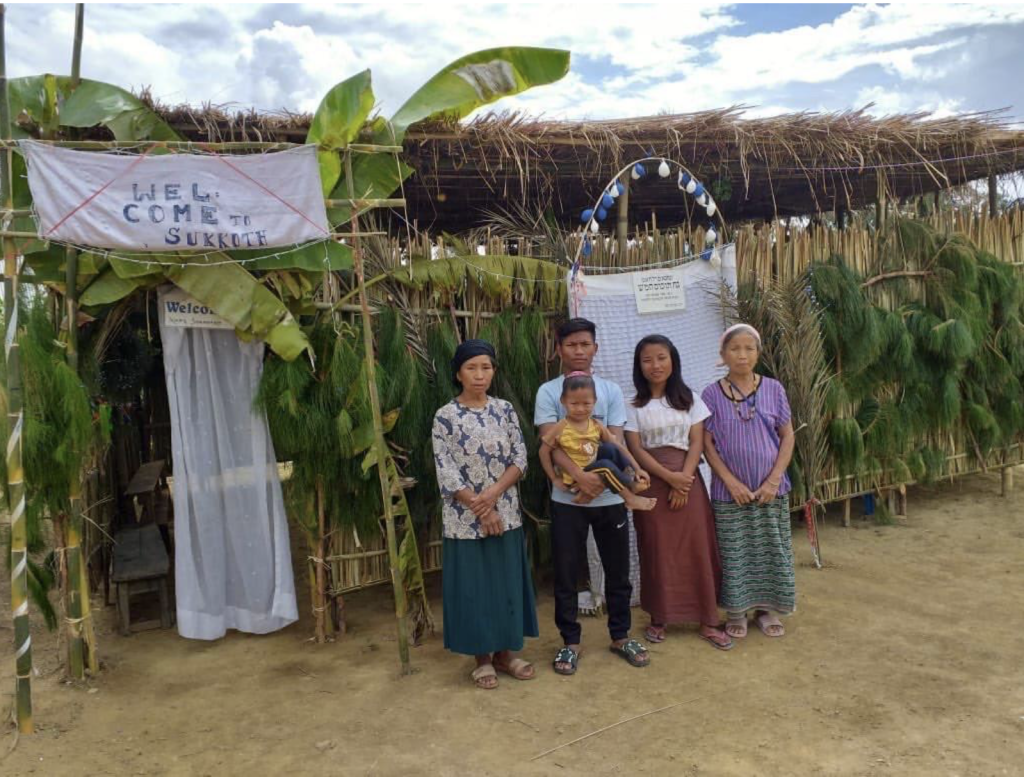
How the crisis shaped Wings of Dawn
In November 2025, the Israeli government approved bringing the remaining community, about 5,800 people, to Israel by 2030, with 1,200 expected by the end of 2026. Advocates had cited Manipur for two years as the reason it could not wait. The crisis has marked the operation in four ways.
It changed the route.
When Israeli rabbis, Jewish Agency staff and embassy officials arrived in December 2025 to screen candidates, they worked from Aizawl, the capital of Mizoram. For Kuki families, who have largely been unable to pass through the Meitei valley since 2023, the road to Jerusalem now runs through a neighbouring state.
It imposed silence.
Some Meitei groups accuse Kuki communities of being illegal immigrants, and current demands for a citizenship register before the census have sharpened that charge. In this climate, emigration is a delicate subject. Reporters visiting Churachandpur in May found members instructed by their elders not to discuss the Aliyah at all.
It compounded the delays.
Departures first planned for February were postponed, then postponed again as conflict in the Middle East escalated. The community found itself squeezed between two fronts: insecurity at home and war at its destination. The first flight finally came in April, and by June about 600 had arrived.
It raised the stakes for those still waiting.
Priority is being given to families reuniting with relatives already in Israel, a humane principle. Yet it also means that those without family ties may wait longest, in a state that remains unstable.
Return first, rescue as well
Community members insist their longing for Zion long predates the crisis; What the violence has done is shorten the clock. ICEJ has stated: This is an Aliyah of rescue as well as an Aliyah of return.
Around 600 Bnei Menashe have arrived since April and begun their new lives in absorption centres in Nof HaGalil and Kiryat Yam. On June 11, PM Netanyahu told the new arrivals that the entire community would be brought home within four years. A second wave of roughly 600 is expected before the end of 2026.
As of September 21, 2026, the security situation in Manipur remains highly volatile and precarious, continuing to pose significant risks to the Bnei Menashe community. Since the outbreak of ethnic violence in May 2023, the state has been effectively partitioned along ethnic lines. The Bnei Menashe, who are ethnically affiliated with the Kuki-Zo tribal groups, remain caught in a broader conflict that has devastated their home regions. While specific, direct targeting of the Bnei Menashe for their Jewish faith has not been widely reported, their geographic concentration in the violence-affected hill districts of Manipur places them at persistent risk.
Background and Community Positioning
The Bnei Menashe community is primarily concentrated in the northeastern Indian states of Manipur and Mizoram. In Manipur, they are predominantly located in the hill districts, which are also the strongholds of the Kuki-Zo tribal communities. The ongoing conflict in Manipur is primarily between the Meitei community (based in the Imphal Valley) and the Kuki-Zo tribal communities (based in the surrounding hills). Because the Bnei Menashe are ethnically integrated into the Kuki-Zo tribes, they are fundamentally identified with the hill communities in this conflict.
Current Security Dynamics (2026)
The security environment in Manipur as of late 2026 is characterized by a tense and armed stalemate.
- Ethnic Segregation and Buffer Zones: The state remains deeply divided. Kuki-Zo communities have largely consolidated control over their hill districts, establishing self-defense forces and local administrations. Movement between the valley and the hills is severely restricted and dangerous. For the Bnei Menashe living in these hill districts, this means they are largely confined to areas under Kuki-Zo influence.
- Persistent Violence: While the massive riots of 2023 have subsided, sporadic violence continues. This includes gunfights between armed groups, targeted killings, and the use of drones for surveillance or attacks. The situation is particularly tense in peripheral areas and along the borders of the hill districts.
- Humanitarian Crisis: Thousands remain in relief camps. The Bnei Menashe, like their Kuki-Zo neighbors, have suffered displacement and loss of livelihood. Access to essential services like healthcare and education in the hill districts remains severely disrupted.
- Central and State Governance: The central government has imposed President’s Rule or maintained a heavy security presence, but it has been unable to fully restore normalcy or bridge the ethnic divide. The state government’s authority is limited in the hill districts.
The International Christian Embassy Jerusalem is a partner of the Jewish Agency in Operation Wings of Dawn.
“If I take the wings of the morning, and dwell in the uttermost parts of the sea; even there shall thy hand lead me.” Psalm 139: 9-10
How can we stand with them?
Pray for peace and justice in Manipur, for protection over families as they travel, for wisdom for those arranging all the logistics, and for a warm welcome in the Galilee.
Your gift to the ICEJ Aliyah fund helps bring the next flights home. (Ref Aliyah BM)
(Howard Flower ICEJ Aliyah director
September 15th, 2026)